
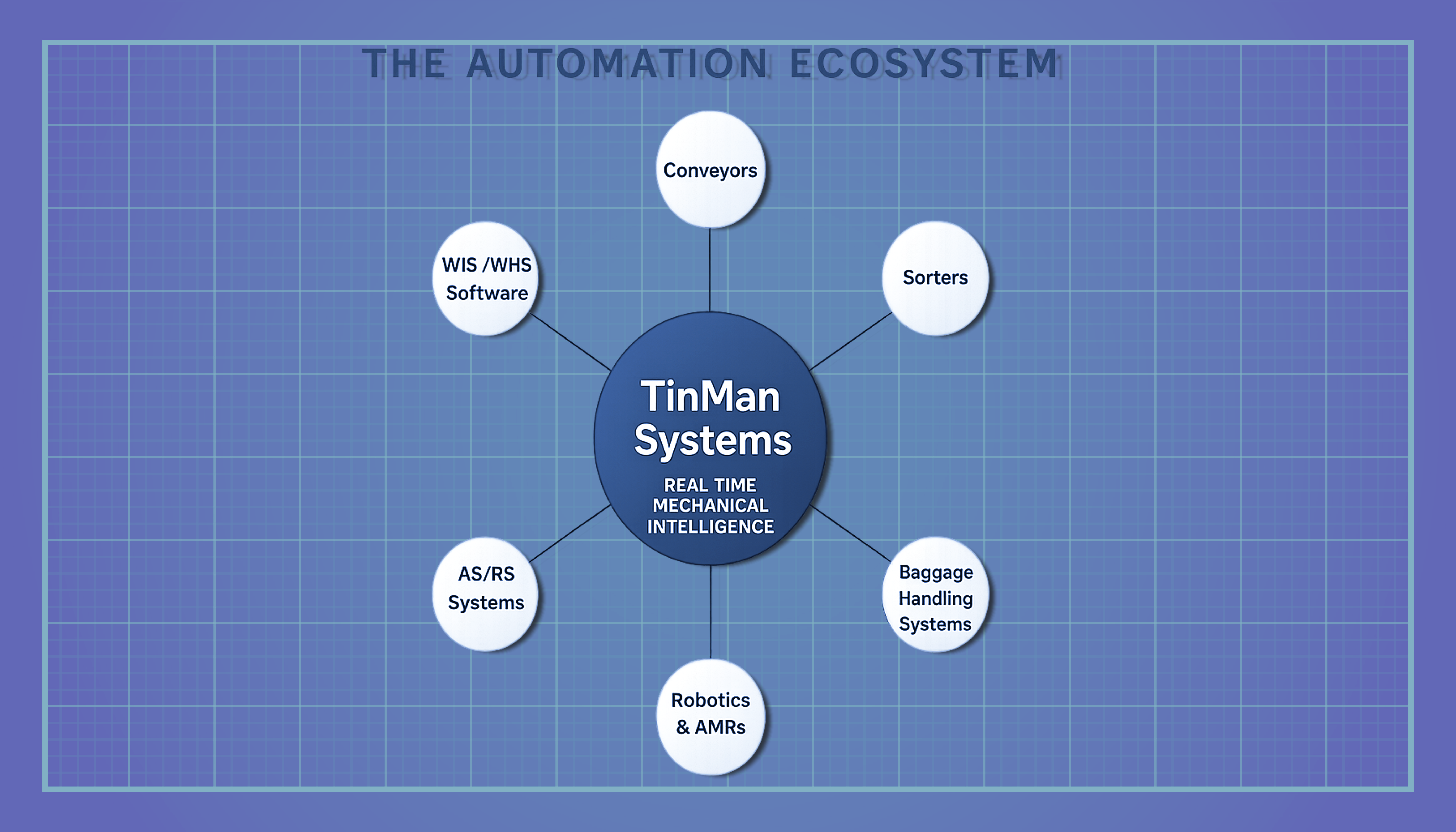
Understanding the Automation Ecosystem
Modern warehouses, parcel hubs, and airports rely on a tightly integrated network of automated systems.
Conveyors move material, sorters route it, baggage systems handle mission‑critical flows, robotics add flexibility,
and AS/RS systems manage storage. Software orchestrates everything.
But all of these systems share one dependency:
If the mechanical systems fail, everything stops.
Industry Insights
Global research firms tracking automation growth point to the same trend: automation systems are scaling faster than the tools used to maintain them. MarketsandMarkets projects the logistics automation market to reach $52.5B by 2029, with hardware representing more than half of total spend. McKinsey reports sustained 10%+ annual growth in warehouse automation, driven by high‑throughput sortation, AMRs, and dense AS/RS deployments.
Foundational Principles (2011–2012)
TinMan Systems’ early work was not academic research, but active development, implementation, and iterative testing of real‑time decision‑making in complex electro‑mechanical systems. Several principles emerged from that work that still hold relevance today:
- iEMA as the atomic unit — intelligent actuators with multi‑sensor inputs and certified performance maps.
- MIMO complexity — real‑time decision making across many sensors and actuators.
- Hierarchical modular decision structures — role‑specific, non‑linear logic enabling simultaneous decisions.
- Multi‑sensor fusion — synchronizing internal and external sensor data to determine true system state.
- Embedded and updateable knowledge — performance maps and decision surfaces that evolve with system changes.
- Open architecture — standardized interfaces enabling scalable intelligence across diverse hardware.
The Blind Spot in Today’s Automation
Integrators build the systems. OEMs supply the hardware. Software directs the flow.
But none of them reveal what’s happening inside the machine:
- Is a sorter drifting out of alignment?
- Are bearings heating up under load?
- Is vibration indicating an early failure?
- Is belt tracking degrading?
- Is a mechanical event about to cause downtime?
This is the gap TinMan Systems fills — the missing layer of real‑time mechanical intelligence.
Technical Forces Reshaping Automation
As automation density increases, mechanical systems operate under higher speeds, tighter tolerances, and continuous duty cycles. Industry research highlights several forces driving the need for real‑time mechanical insight:
- High‑frequency vibration signatures reveal early bearing wear, roller degradation, and imbalance.
- Thermal behavior under load exposes friction, misalignment, and motor stress long before failure.
- Alignment and tracking dynamics become critical as conveyors and sorters run at extreme speeds.
- Acoustic pattern deviations correlate with friction events, mechanical drag, and component fatigue.
- Multi‑sensor fusion provides the most reliable picture of system health by combining vibration, thermal, acoustic, motion, and video data.
These signals exist in every automated facility — but until now, they’ve been invisible during live operation.
Real‑Time Mechanical Intelligence in 2025
The core ideas from the original TinMan Systems architecture have become even more relevant as automation has accelerated. Today’s facilities operate with higher speeds, greater mechanical density, more autonomous subsystems, and more software orchestration layers. Yet the mechanical layer still lacks real‑time self‑awareness.
This modern interpretation evolves the original architecture into a practical, deployable loop:
- Inanimate sensing — continuous vibration, thermal, acoustic, positional, and video signals.
- Synchronized multi‑sensor fusion — time‑aligned, context‑aware merging of signals across systems.
- Real‑time interpretation — non‑linear models identifying drift, degradation, and emerging failure modes.
- Intelligent decisions — system‑level recommendations and machine‑level insights.
- Actuation and operational influence — adjustments based on real‑time mechanical truth.
- Closed‑loop reinforcement — every action generates new sensor data, completing the MIMO cycle.
Where TinMan Systems Fits in the Ecosystem
TinMan Systems provides the diagnostic layer beneath every automation system — revealing the mechanical truth inside conveyors, sorters, and baggage handling systems.
MCIS
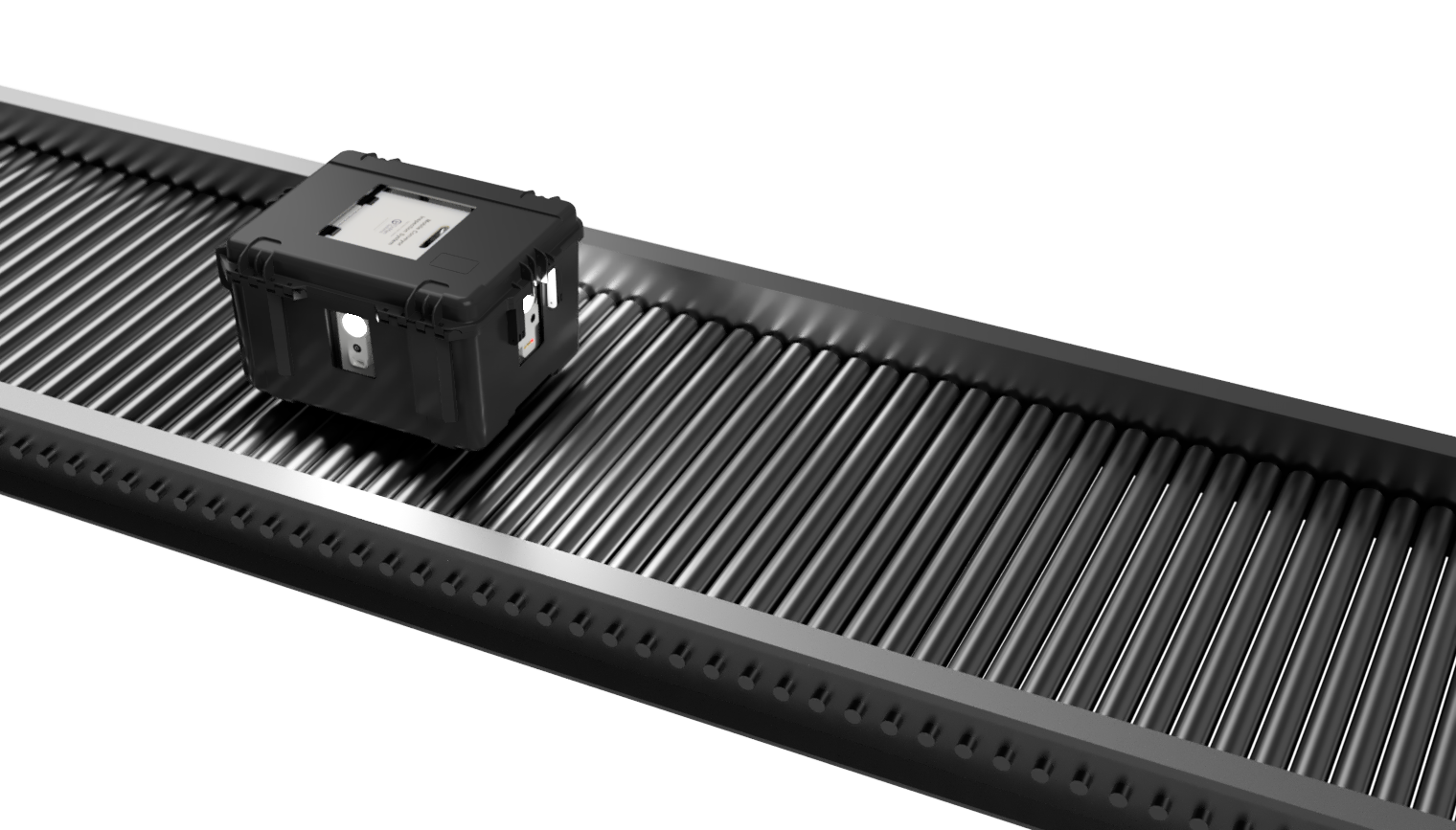
Mobile Conveyor Inspection System for real‑time vibration, thermal, alignment, and video diagnostics. Captures belt behavior, roller condition, friction events, and mechanical anomalies during live operation.
Explore MCIS →SORTERVision
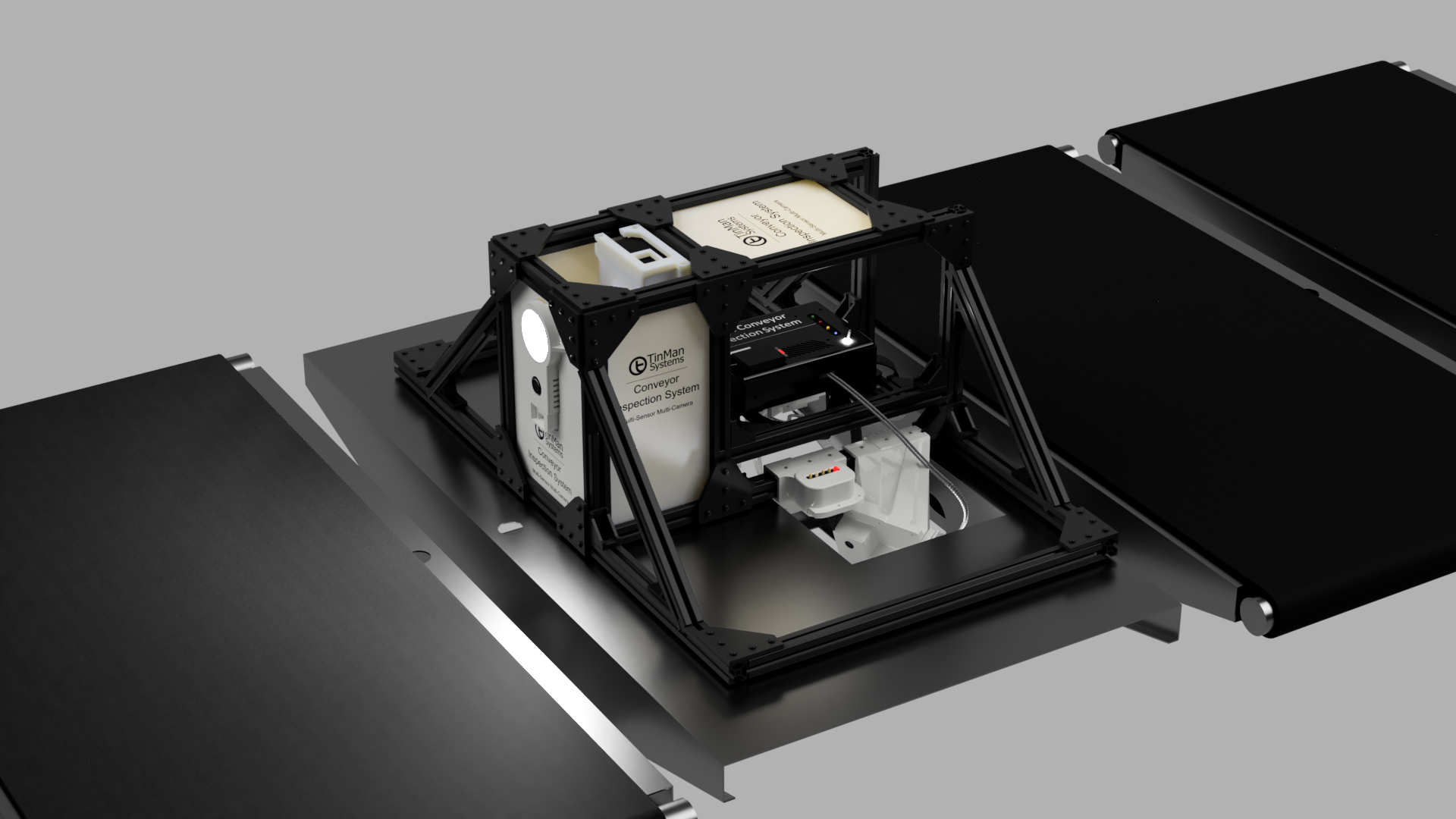
Inside‑the‑machine diagnostics for cross‑belt, tilt‑tray, and shoe sorters. Multi‑sensor data, thermal signatures, mechanical behavior, and real session playback reveal issues long before downtime.
Explore SORTERVision →Cascades
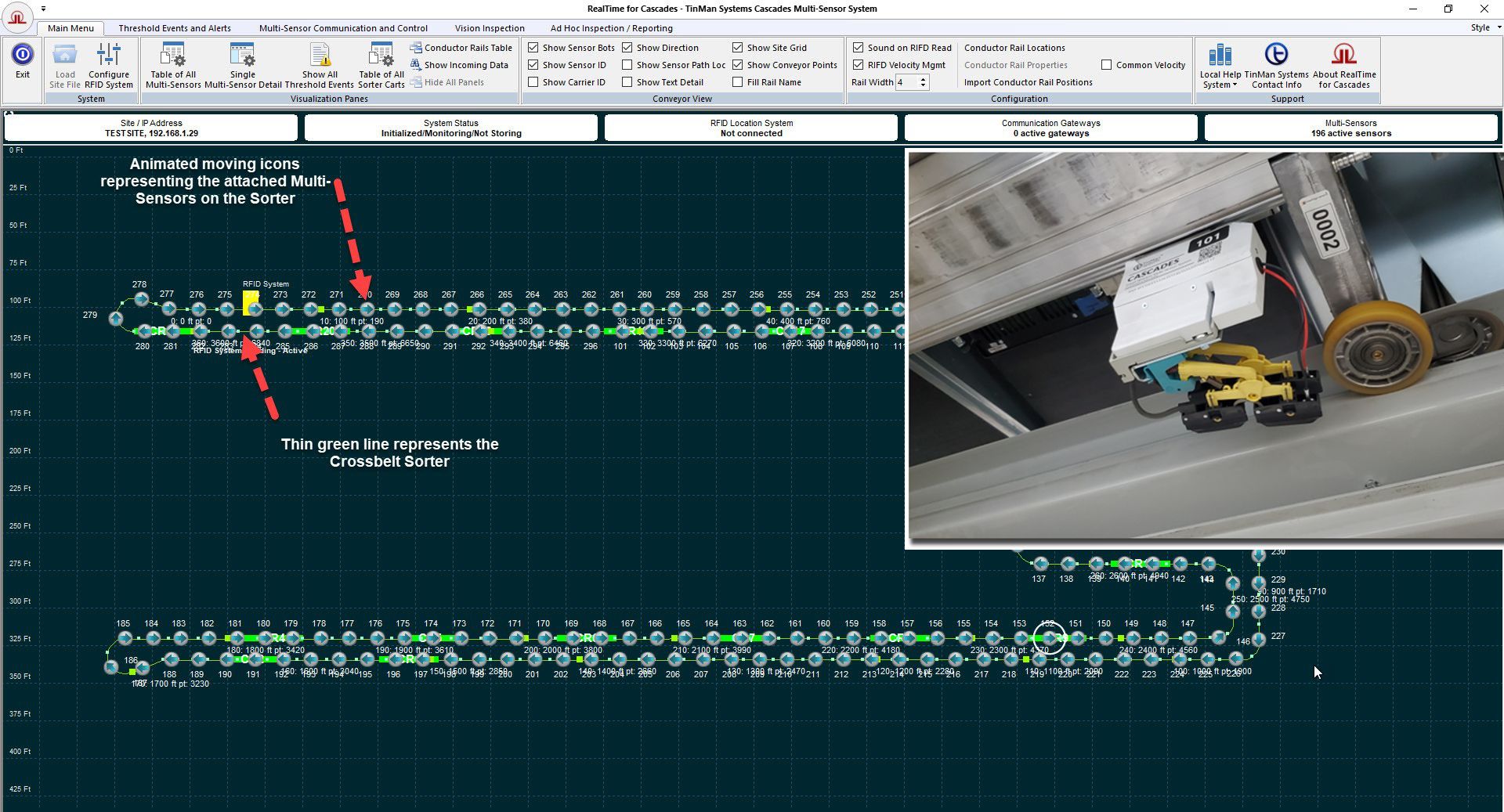
Continuous, wireless multi‑sensor monitoring for baggage handling and conveyor systems. Tracks vibration, temperature, and acoustic signatures to enable predictive maintenance and long‑term reliability.
Explore Cascades →The Thinking Behind TinMan Systems
When I first developed and implemented this architecture more than 15 years ago, the landscape looked very different. AI, robotics, and autonomous systems have advanced at an extraordinary pace since 2011, achieving capabilities that were difficult to imagine at the time. Yet one thing hasn’t changed: automation continues to outpace its own diagnostics. The mechanical systems driving these environments still operate largely without real‑time understanding of their own behavior.
That’s why the full‑circle loop remains essential — inanimate systems capturing raw mechanical signals, multi‑sensor fusion synchronizing them, real‑time interpretation extracting meaning, intelligent decisions determining action, and actuators closing the loop back into the physical environment.
TinMan Systems was built on that foundation. Not as another monitoring layer, but as the real‑time mechanical intelligence that helps automation keep up with the speed at which it now operates.” — Karl Hirsch, Founder & CEO, TinMan Systems
2011–2012 Technical White Paper (archival reference)